Moving Medication: Tai Chi’s Impact on Balance Self-Efficacy in Occupational Performance
*Corresponding Author(s):
Dr. Christopher Taylor, OTD, OTR/L, BCGMayo Clinic, Phoenix, Arizona, United States
Tel:+1 8282468146,
Email:Taylor.Christopher@mayo.edu
Abstract
This research project is intended to evaluate Tai Chi’s impact on balance self-efficacy in occupational performance specifically in regard to individuals with Mild Cognitive Impairment (MCI). Participants (N=18) were individuals and their partners pre-screened and accepted into the Mayo Clinic’s HABIT (Health Actions to Benefit Independence & Thinking) Program. HABIT is a 10-day holistic wellness program offered to individuals living with a diagnosis of amnestic MCI. Participants engaged in daily 45-minute standing, seated, and/or floor exercises for two weeks (10 sessions); each 45-minute session included a 15-minute warm-up (range of motion, stretching), 20 minutes of Tai Chi exercises, and a 10-minute cool-down (mindfulness, breathing exercises). On average, functional self-efficacy scores of participants with MCI increased from 59.8% to 74.6% (p-value = .00736). Results indicate that Tai Chi is an effective intervention to increase balance self-efficacy when performing daily activities in both individuals with and without MCI.
Introduction
Self-efficacy is defined as the belief in one’s ability to meet the challenges ahead and complete a task successfully. This core belief is considered the foundation of human motivation, performance accomplishments, and emotional well-being; unless individuals believe they can produce desired effects by their own actions, individuals may have little incentive to undertake activities [1]. Studies show that targeting self-efficacy is an effective means of increasing physical activity and occupational performance. However, evidence concerning which are the most effective techniques for changing self-efficacy is lacking [2]. This research project is intended to evaluate Tai Chi’s impact on balance self-efficacy relating to occupational performance specifically in regards to individuals with Mild Cognitive Impairment (MCI).
Alzheimer’s Disease (AD) is a significant public health concern and economic burden. The disease initially affects memory but ultimately renders the individual incapable of even the most basic of activities of daily living [3]. MCI is the stage between the expected cognitive decline of normal aging and the more serious decline of AD. In general, reduced balance control and increased cognitive impairment are both well-established risk factors for falls among older adults; as a result, falls and fall-related injuries are more common in individuals with MCI than in healthy controls [4].
Often referred to as the “exercise of longevity”, Tai Chi is a Chinese martial art that practices meditation in motion. Tai Chi has been shown to be effective in improving balance, proprioception, muscle strength, and endurance [5]. Tai Chi may be particularly beneficial to older adults with MCI because it incorporates both physical and mental activity. Tai Chi requires whole-body coordination of continuous, rhythmic movements with dynamic weight shifting and single limb support [6].
Design
This research project used a quasi-experimental design study. Participants (N=18) were individuals and their partners pre-screened and accepted into the Mayo Clinic’s HABIT (Health Actions to Benefit Independence & Thinking) Program. HABIT is a 10-day holistic wellness program offered to individuals living with a diagnosis of amnestic MCI. Participants were required to have a partner who would be included in the program; partners were independently functioning friends or family members dedicated to the participant’s successful completion of the program.
Co-led by both a certified Tai Chi instructor and a certified Yoga instructor, participants engaged in daily 45-minute standing, seated, and/or floor exercises for two weeks (10 sessions). Each 45-minute session included a 15-minute warm-up (range of motion, stretching), 20 minutes of Tai Chi and Yoga exercises, and a 10-minute cool-down (mindfulness, breathing exercises). The majority of exercises involved movements associated with Dr. Paul Lam’s Tai Chi for Arthritis and Fall Prevention Program through the Tai Chi for Health Institute. Self-efficacy strategies (See Figure 1) were implemented throughout sessions.
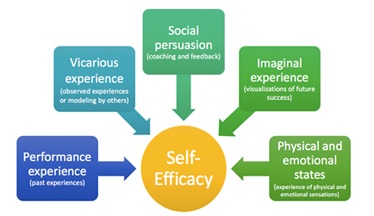 Figure 1: Key Components of Self Efficacy.
From “Self-Efficacy Toolkit,” https://www.transformingeducation.org/self-efficacy-toolkit/
Pre Test / Post Test
Participants were encouraged to complete a self-report Likert scale questionnaire which measured balance self-efficacy of completing various daily tasks (See Figure 2). The survey was developed for this study and has not been standardized; inspiration taken from the Activities-Specific Balance Confidence (ABC) scale-- modified to incorporate additional functional measurements. Pre-test was administered ~48 hours prior to the first Tai Chi session, and posttest was administered following the final Tai Chi session. Data not included in the analysis were scores for participants who did not complete 10 out of 10 Tai Chi sessions.
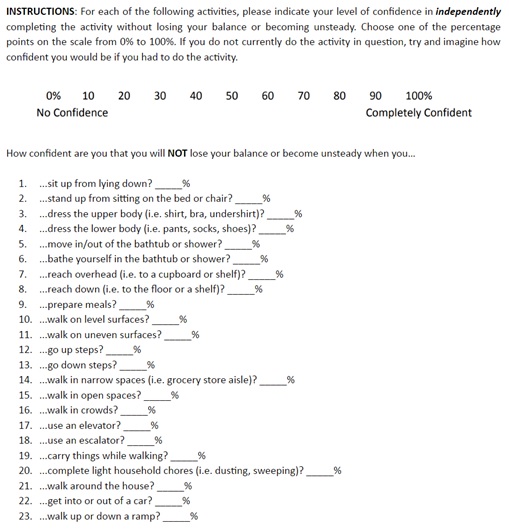 Figure 2: Balance Efficacy Likert Scale Questionnaire.
Results
Results were analyzed using a Wilcoxon Signed-Rank Test. The Wilcoxon signed-rank test is a non-parametric statistical hypothesis test used to compare two related or matched samples to assess whether their population means ranks differ [7]. Wilcoxon Signed-Rank Test reported z-value of -2.6783 and p-value of .00736. The results are significant at p < .05. In addition, when comparing averages, the total number of items reported with 100% confidence increased from 165/276 to 206/276 (participants with MCI) and from 91/138 to 119/138 (partners) representing an approximate increase in perceived confidence of 14.9% (participants with MCI) and 20.3% (partners) over the two week time frame (See Chart 1). Individualized scores are reported below (See Charts 2 & 3).
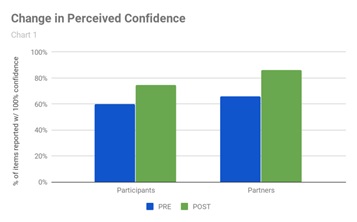 Chart 1: Change in perceived confidence.
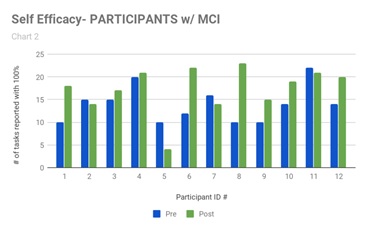 Chart 2: Self efficacy participants w/ MCI.
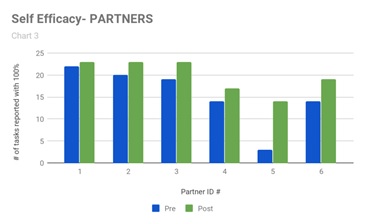 Chart 3: Self efficacy partners.
Discussion
The findings from this study adds to the growing evidence that supports the biomechanical and psychosocial benefits of Tai Chi. Specifically, this study indicates that daily Tai Chi performance can lead to an increase in balance self-efficacy when completing daily tasks in both individuals with and without MCI. The results show average balance self-efficacy scores of participants with MCI increased from 59.8% to 74.6% and partners’ average scores increased from 65.9% to 86.2% demonstrating a statistically significant improvement.
Several limitations were presented during the completion of this study. Due to decreased cognition, self-reported data for individuals with MCI may be less reliable. The participants’ with MCI scores fluctuated more than their paired partner with some participants reporting decreased self-efficacy. This decrease only occurred in the participants with a diagnosis of MCI; therefore, it is possible that fluctuations in memory and decreased higher level reasoning skills impacted self-reporting. Additional limitations include: a heavy integration of Yoga techniques and movements, a lack of standardized and objective assessments, and no formal Tai Chi style was utilized such as Yang or Hong.
Suggestions for further research include remedying many of the above mentioned limitations such as incorporating standardized assessments (such as Barthel ADL Index, Balance Self-Efficacy Scale (BES), and/or BERG Balance Scale) and focusing solely on one formal Tai Chi style such as Lam’s Tai Chi for Fall Prevention or Yang’s 24-form (See Figures 3-8) while eliminating comparable Yoga movements.
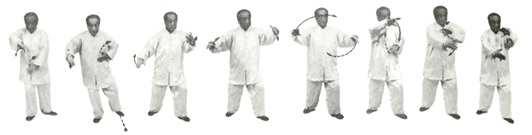
Figure 3: Break-down of higher complexity Tai Chi movements.
From “T’ai Chi Ch’uan: National 24 Form,” by M. Garofalo. http://www.egreenway.com/taichichuan/short.htm.
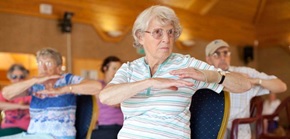 Figure 4: Maintaining attention to task while implementing dynamic seated movements.
From “Wyvern Tai Chi and Qigong,” by G. Bellinger, n.d., https://www.wyverntaichi.com/taichiinnursingandcarehomes.html.
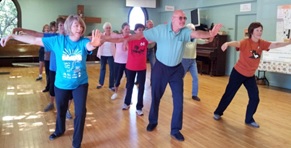 Figure 5: Attending group Tai Chi classes for seniors is a great way to adapt a routine practice & socialize with others.
From “Tai Chi for Seniors- The Complete Guide,” by J. Hegg, 2017.https://www.vivehealth.com/blogs/resources/tai-chi-for-seniors.
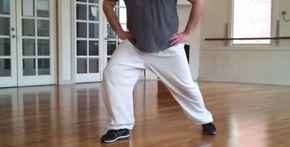 Figure 6: Basic stepping is used to transition from move to move.
From “Tai Chi for Seniors- The Complete Guide,” by J. Hegg, 2017.https://www.vivehealth.com/blogs/resources/tai-chi-for-seniors.
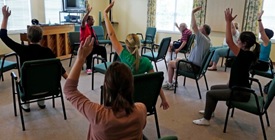 Figure 7: Seated Tai Chi classes are a safe and easy way to modify challenging Tai Chi moves for seniors who may have balance issues.
From “Tai Chi for Seniors- The Complete Guide,” by J. Hegg, .https://www.vivehealth.com/blogs/resources/tai-chi-for-seniors.
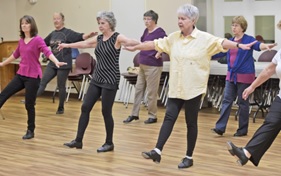 Figure 8: Participants completing single leg stance during class at Santa Clarita Valley Senior Center.
From “The Signal,” by D. Watson, https://signalscv.com/2017/06/senior-events-calendar/.
Conclusion
In this study, the effectiveness of Tai Chi on balance self-efficacy in occupational performance was examined; self-reported pre-test scores were compared with post-test scores to determine the change of perceived confidence in completing daily functional tasks. After completing ten 45-minute Tai Chi sessions, statistical analysis concluded that daily Tai Chi practice resulted in a statistically significant improvement in balance self-efficacy scores. While this study's results demonstrate an improved balance confidence in performing daily tasks, future studies could examine the direct impact of Tai Chi on performance of daily occupations. It is possible that outcomes are skewed due to study limitations such as a lack of objective assessments and a small sample size. As a result, further research should consider eliminating these confounding variables. Regardless, results indicate Tai Chi is an effective intervention to increase balance self-efficacy in both individuals with and without Mild Cognitive Impairments.
References
- Bandura A (2010) Self-efficacy. The Corsini encyclopedia of psychology 1-3.
- Williams SL, French DP (2011) What are the most effective intervention techniques for changing physical activity self-efficacy and physical activity behaviour—and are they the same? Health education research 26: 308-322.
- Au B, Dale-McGrath S, Tierney MC (2017) Sex differences in the prevalence and incidence of mild cognitive impairment: a meta-analysis. Ageing research reviews 35: 176-199.
- Tangen GG, Engedal K, Bergland A, Moger TA, Mengshoel AM (2014).Relationships between balance and cognition in patients with subjective cognitive impairment, mild cognitive impairment, and Alzheimer disease. Physical Therapy 94: 1123-1134.
- Huang ZG, Feng YH, Li YH, Lv CS (2017) Systematic review and meta-analysis: Tai Chi for preventing falls in older adults. BMJ open 7: 013661.
- Sungkarat S, Boripuntakul S, Chattipakorn N, Watcharasaksilp K, Lord SR (2017) Effects of tai chi on cognition and fall risk in older adults with mild cognitive impairment: a randomized controlled trial. Journal of the American Geriatrics Society 65: 721-727.
- Lowry R (2014) Concepts and applications of inferential statistics.
Citation: Taylor C (2020) Moving Medication: Tai Chi’s Impact on Balance Self-Efficacy in Occupational Performance. J Altern Complement Integr Med 6: 122.
Copyright: © 2020 Dr. Christopher Taylor, OTD, OTR/L, BCG, et al. This is an open-access article distributed under the terms of the Creative Commons Attribution License, which permits unrestricted use, distribution, and reproduction in any medium, provided the original author and source are credited.